Get lesson updates sent to your inbox.
Thanks — we received your request to get SMS updates from Kulture (1-833-KULTURE). Reply STOP to unsubscribe. Reply HELP for help.

Get lesson updates sent to your inbox.
Thanks — we received your request to get SMS updates from Kulture (1-833-KULTURE). Reply STOP to unsubscribe. Reply HELP for help.
The universe should be studied by everyone, not just scientists.
Explore subjects and lessons we support.
Human experience is not simply the product of external circumstances or instructions. We continuously generate thoughts, identities, behaviors, and relationships through interactions with ourselves and our environments. Self-generating describes the capacity of a human to produce its own organization through these ongoing interactions.

Some of the most consequential patterns in life arise through interactions rather than planning or centralized control. Emergence describes how something new can arise from the relationships among individual parts.
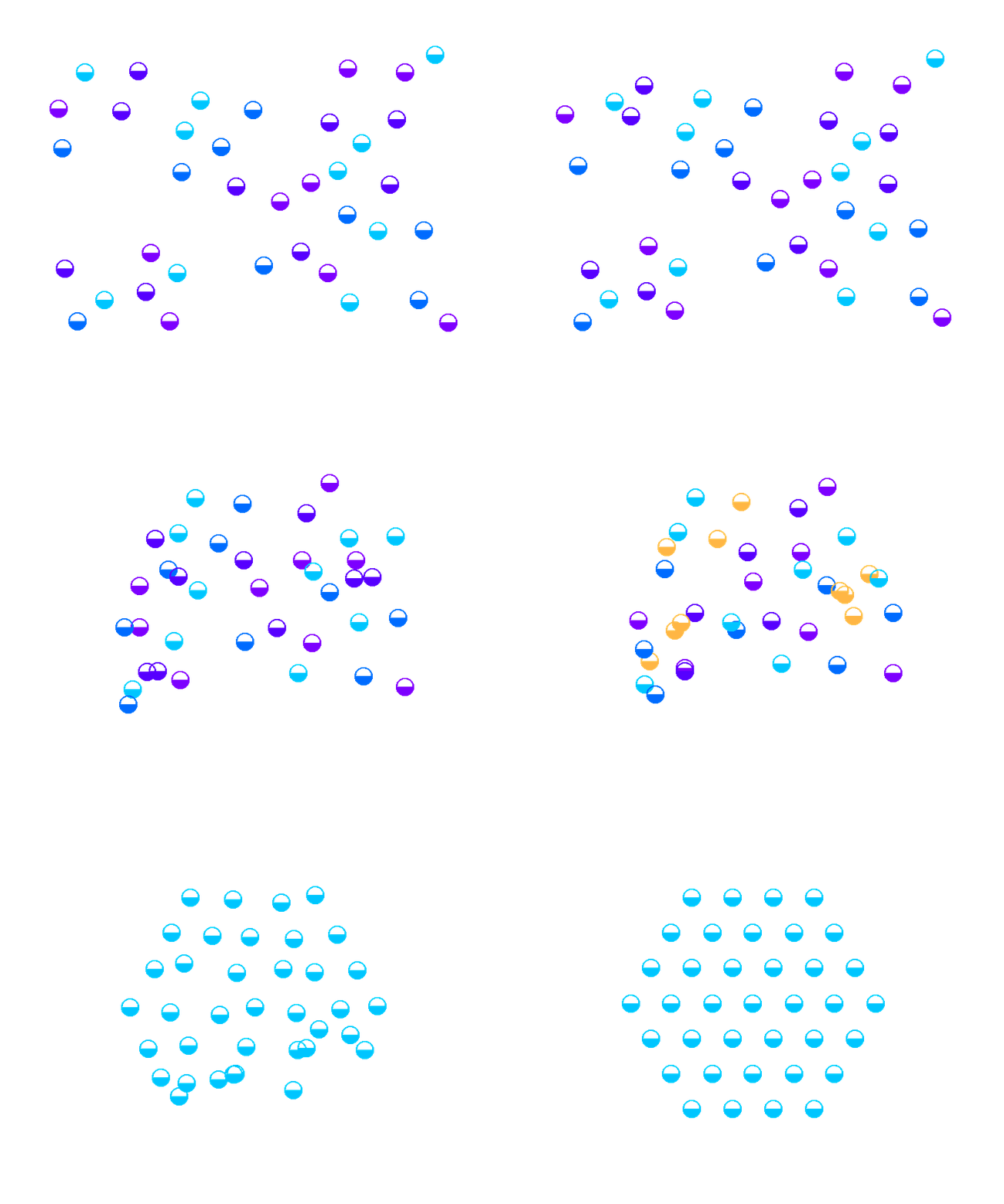
Human experience unfolds over time, with our thoughts, behaviors, relationships, and environments continuously changing. Longitudinal coherence describes the capacity for these changing elements to remain substantially connected and coordinated across time. It is not about maintaining a fixed identity or state, but sustaining an underlying organization that can adapt and remain functional through change.
What makes an experience feel like something? Scientists study how brain activity relates to awareness, but there is no settled explanation of how subjective experience arises.
Our choices are shaped by habits, circumstances, and processes outside awareness. We can study how people weigh options and guide their actions while the broader question of free will remains debated.

Emotions involve changes in the brain and body, shaped by how we interpret a situation. They can influence what we notice, remember, and do next.

Seeing begins with light reaching the eyes. The brain uses those signals, together with context and prior experience, to make sense of what is around us.
Light is electromagnetic radiation; visible light is the range our eyes can detect. Light supports vision, and its timing helps regulate our daily rhythms.

The matter in our bodies is made of atoms, which contain electrons and nuclei. At smaller scales, particle physics investigates the constituents of matter and how they interact.
Waves describe disturbances that travel through a medium or field. Sound and light both show wave behavior, though sound needs a material medium and light can travel through a vacuum.

A field assigns a value to each point in space and time. Electric and magnetic fields help describe interactions essential to matter, light, and electrical signaling in the body.
Other people help shape how we learn, feel, and respond. Social neuroscience studies the brain processes involved in interaction, including how we understand others and respond to social cues.
Light, noise, temperature, and social conditions can affect how we feel and function. Their effects depend on the person, the intensity, and how long exposure lasts.

Breathing, circulation, metabolism, and other processes keep us alive. The body continually adjusts these interacting systems as activity, needs, and surroundings change.
Experience changes what we can remember and how we respond. Memory involves encoding, retaining, and retrieving information; remembering can also reshape what we recall. What stays with us depends in part on attention, context, and prior learning.

Our biology carries a history that extends across generations. Genetic inheritance and environmental conditions contribute to how we develop, while evolution changes the inherited characteristics of populations over generations. Natural selection is one part of that process, alongside mutation, genetic drift, and gene flow.
We take in more information than we can attend to at once. Attention helps prioritize what matters for a task, while focus involves sustaining that attention over time. What draws us in depends on our goals, our surroundings, and our current state.

Demands and perceived threats can change how we think, feel, and respond. Stress responses can help us meet a challenge, but their effects depend on intensity, duration, and opportunities for recovery. Fear often centers on an immediate threat; anxiety often involves anticipating possible threats.
How can we learn what another person experiences? People may communicate through words, gestures, or other deliberate responses. When someone cannot report, researchers look for other behavioral and brain-based evidence.